Curbside Service

For Phoenix-area concrete contractor, GNSS solution brings the speed they need.

TWC article web hero
The road paving process is often viewed as something that takes place in the latter stages of any project — a wrap-up function, if you will. Get the road in, then: open the distribution center, bring prospective tenants in to view houses in the new residential development, cut the ribbon on the wastewater treatment facility, etc. 

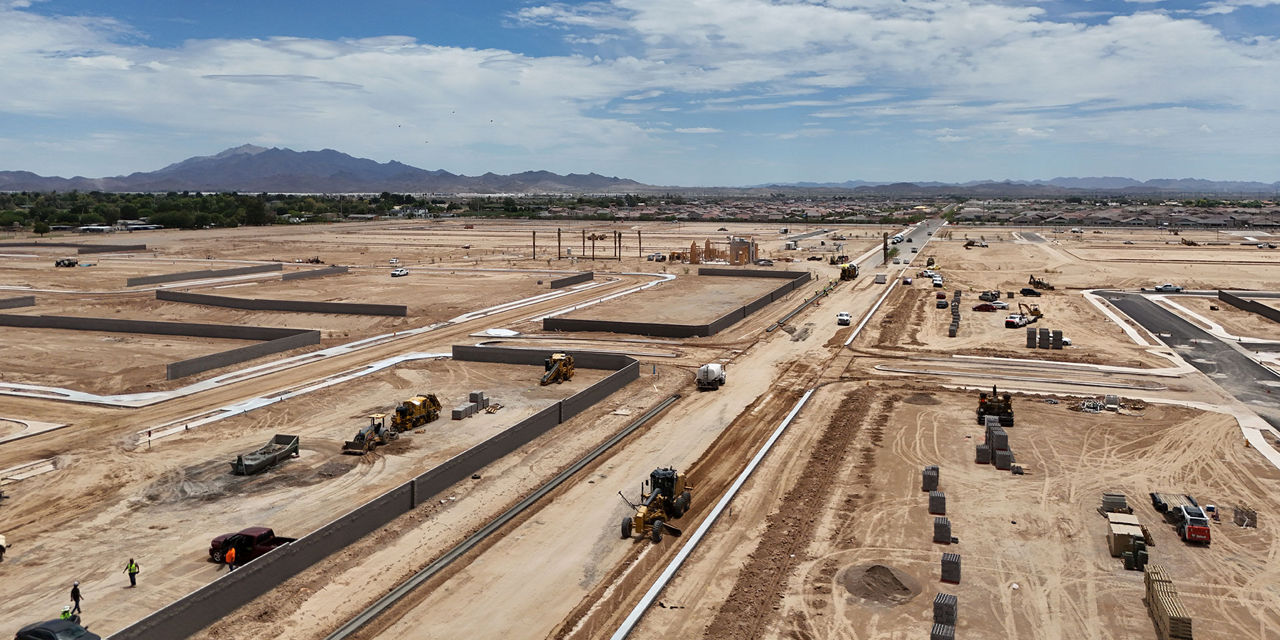
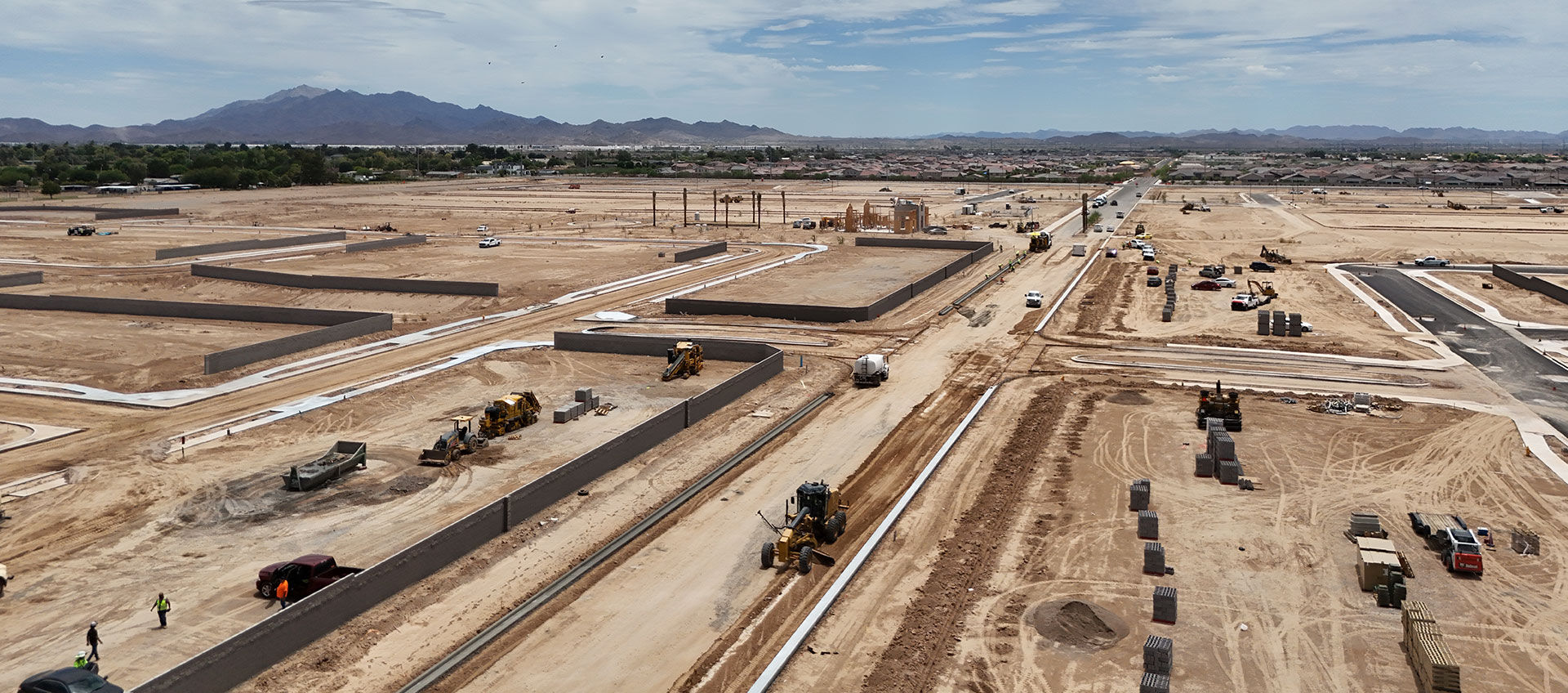
While that can be true in many cases, progress can sometimes be dictated by the very need for a road — when municipal restrictions dictate it, for example. Such was the case for TWC Contracting at a sizeable development called La Privada outside of Goodyear, Arizona. There, the company was tasked with installing 3,000 feet of curb and gutter for a critical infrastructure road, doing so on short notice and facing the tightest deadline imaginable. An impossible task for most other area companies, TWC was able to meet that challenge, largely due to the GNSS-based paving solutions it relies upon daily. Right now, no curb and gutter specialist in the Valley of the Sun is shining brighter.
Building the Wall

A subsidiary of multi-faceted entity The Wallcor Companies, TWC Contracting was established in 2020 as a standalone concrete, masonry and earthmoving company. Through a combination of hard work, a focus on quality, a committed team, and an embrace of available technology, they quickly became a driving force in the area. That last point in particular, a willingness to adopt new paving solutions, has separated them from the pack, according to Mark Wible, the company’s general manager.


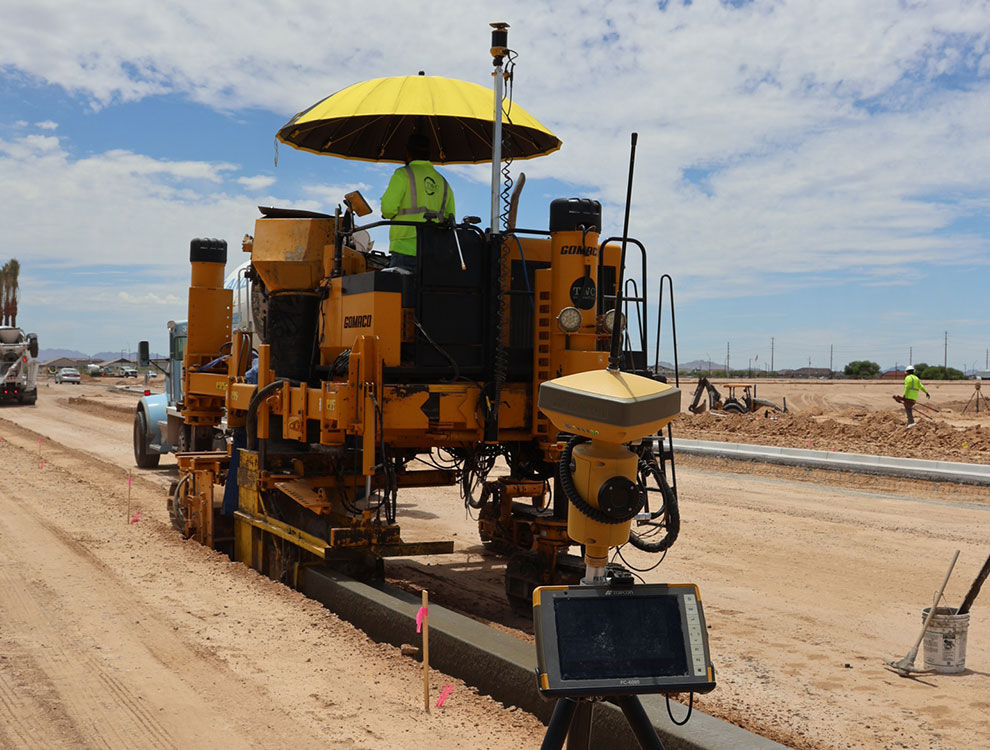
“We first added the technology to our operation — Millimeter GPS on a GOMACO Commander III and GPS machine control on a motor grader — in April 2025,” said Wible. “From a company perspective, it was not a smooth transition. At the time, some of the blade operators we had working for us were old school: very traditional in how they preferred to work. They went to ownership and demanded that GPS be taken off the equipment, believing, I suppose, that it would ultimately cost them their jobs. But I knew what it could do for them and for our overall operation and stood firm. While we lost some good quality, experienced guys, the progress we’ve made since that time speaks for itself.”

TWC article web teaser image

Today, not even a decade since establishing their presence, TWC Contracting has more than 200 people working in support of the concrete operation and the company is one of the most in-demand concrete contractors in the area. Three months after that first GPS package purchase, TWC ordered two more Topcon Millimeter GPS systems for their other two GOMACO curb machines, as well as an additional two GPS machine control systems for the remaining two Caterpillar motor graders in their fleet. “And we just ordered a fourth curb machine along with a John Deere 210 tractor which will also have Topcon machine control,” added Wible. “It’s worth noting that we also have a curb machine that is not GPS-equipped and it rarely leaves the yard. Our guys won't run it, saying they are through with string line; that’s quite a turnaround.”

"It’s worth noting that we also have a curb machine that is not GPS-equipped and it rarely leaves the yard. Our guys won't run it, saying they are through with string line; that’s quite a turnaround.”

Getting a Jump on It

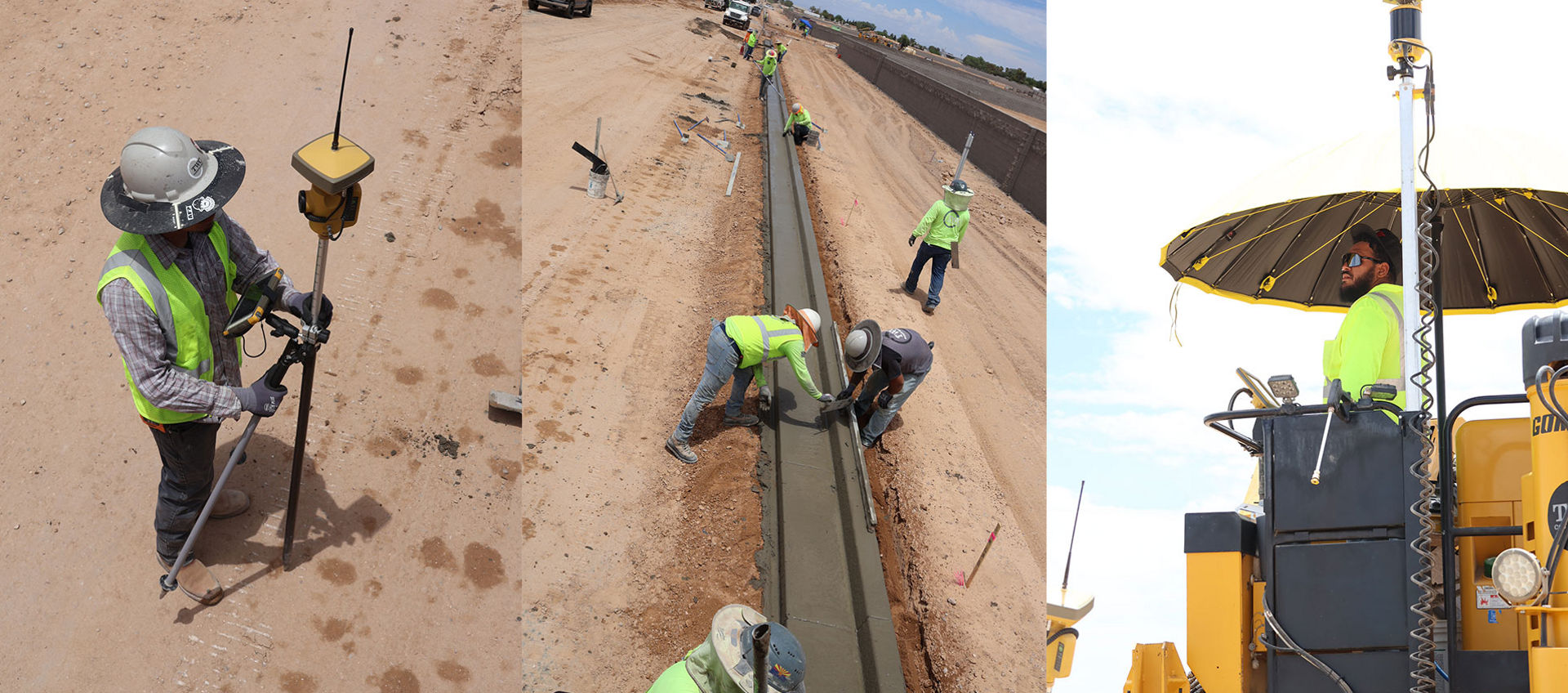
That reluctance to return to the old way of doing things stems from the ease with which TWC’s crews can now tackle even the most challenging paving jobs —  like the one at La Privada. According to Wible, while the Topcon Millimeter GPS solution they use allows for a stringless operation — a huge advantage — it also dramatically reduces their reliance upon traditional surveying.


“That has made all the difference in our ability to get onsite and working immediately, rather than waiting until survey can stake out the job,” he said. “We got the call for the La Privada project and a dictate that the developer needed to have the infrastructure road totally done within two weeks from that call, giving us just three days to complete curb and gutter, tie-ins and concrete structures. In the Phoenix area, survey companies typically have a two- to three-day lead time just to come out. Waiting for that to happen would have made that deadline impossible.”


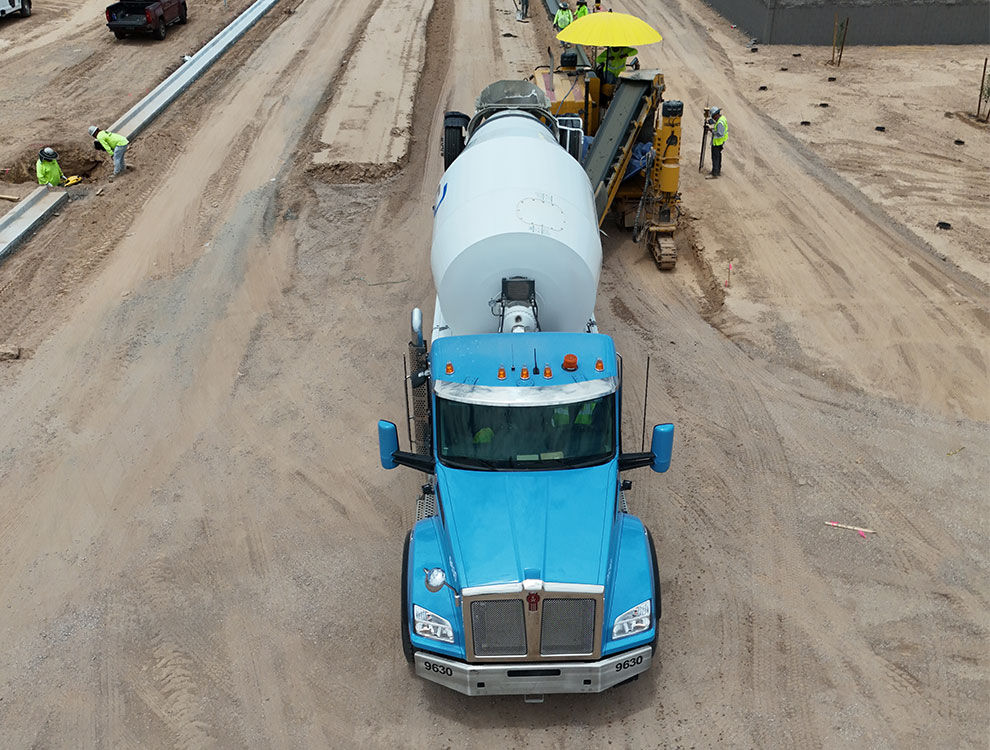
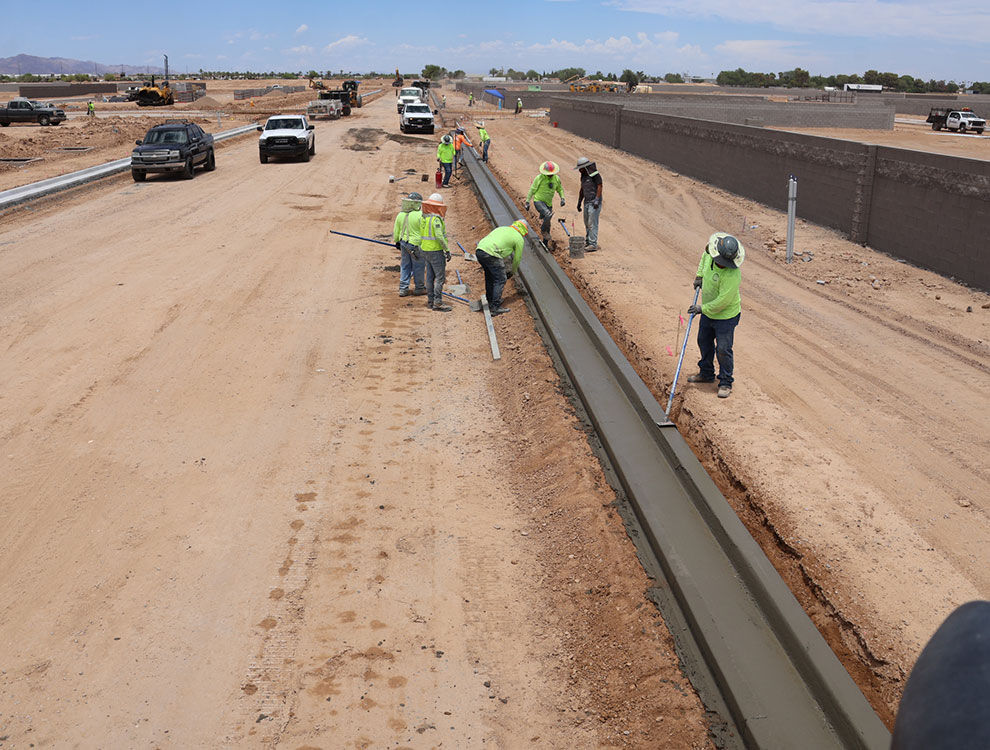
Instead, he said, working with an outside source, they had the model for the project created. Then, using a pair of Cat 140M motor graders running Topcon MC-Max machine control, got the grade set and immediately began pouring curb and gutter. “We put down better than 2,900’ of curb — about 160 cubic yards of concrete —  that first day and never looked back,” he said. 

TWC article web teaser image

In the Zone

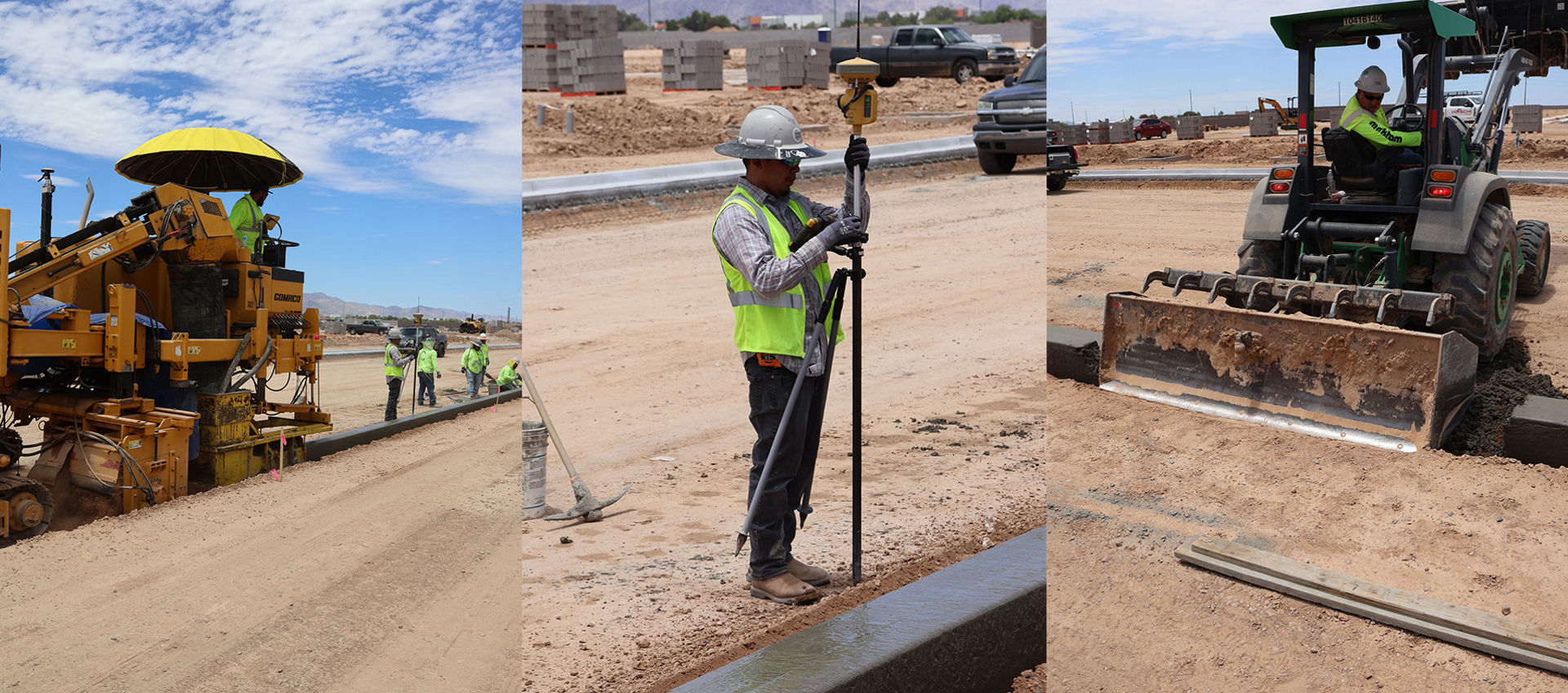
TWC’s Millimeter GPS solution centers around a Lazer Zone transmitter and receiver as well as a GNSS antenna. Unlike a standard rotating laser which can lose accuracy over long distances, the Lazer Zone transmitter can cover nearly 1,000 feet horizontally and 30 feet vertically with millimeter-grade accuracy.

“To avoid the need for ‘leapfrogging’ a single transmitter, we use three of them for maximum coverage and minimal movement,” said Wible. “Our curb machine’s receiver acquires the transmitter’s signal, decodes the information and gives us a precise, millimeter-level, vertical position for curb placement.” 

The String’s a Thing

The difference between their current operation and that of the past is stark. While still reliable and widely employed, stringline paving is increasingly being recognized for what it is: a lengthy, labor-intensive, costly process which can be prone to errors. According to Wible, in addition to the time needed for a survey crew to get on site and do its work, the preparation that follows can be daunting.

“In the past, once survey staked things out, we would set the stringline, then come back and true it up by eye,” he said. “Even survey elevations can be up and down by a couple of hundredths, and we don’t want our curb to reflect that. So the setup time is considerable, and the tear-down time/effort is only slightly better. All that is eliminated with the Topcon Millimeter GPS solution. And should something occur on this job that threatens to hold things up, we can easily take our crew to another job and, as long as I have control points, immediately start putting curb on the ground there. As a result, company productivity doesn’t suffer.”

He added that their embrace of the technology has not gone unnoticed by colleagues in the business. “There is another area contractor whose path often crosses with ours,” he said. “They started using GPS even before we did, but for some reason didn’t see the value or the advantage in it and went back to doing things the traditional way. However, once they saw how productive we were on some of our other projects, they suddenly brought their solution out of mothballs and have been using it ever since. That speaks volumes.”

"We put down better than 2,900’ of curb — about 160 cubic yards of concrete — that first day and never looked back.”

A Word About Support

Wible makes no attempt to downplay the important role support plays in both his daily operation and in his machine/technology purchase decisions. Because his family has worked with Gilbert, Arizona-based Branco Machinery, for decades, he genuinely values that bond.

“Kevin Strand at Branco has been there for us time and again —  you can’t understate the importance of a relationship like that,” he said. “Similarly, when Topcon’s Brian Lingobardo showed us what was possible with the Millimeter GPS solution and then helped make it happen for us, I felt this was a company I wanted to do business with. We knew that once we made the first machine purchase, all of our machines and our ancillary equipment was going to follow. That’s definitely been the case, and it’s largely been predicated on relationships.”

Take it to the Bank

When asked how much their embrace of GNSS-based technology benefits their customers, Wible’s answer is twofold. He admits that, because of all the variables that exist in each project, it is tough to nail down a “concrete” number. He will say, however, that they are infinitely more productive than they could ever hope to be using stringline.


“I can cite its value in a different way, though,” he said. “There is a component of many real estate transactions called debt service —  interest paid to a land bank by developers for every day construction is occurring until it is fully complete. In many cases, it can be tens of thousands of dollars per day. So, even if our initial bid might be higher than that of a competitor, if we are able to take a week or two out of our schedule by streamlining the workflow through automation, we might actually save that customer $100,000 or more by reducing their debt load.”


And that number is not simply wishful thinking on anyone’s part. Wible said that on the La Privada project, their ability to get in and working quickly, coupled with the wealth of other automation advantages easily shaved 8-10 days off the project’s duration. “Those numbers, coupled with our amazing team of employees, are two major keys to the success we’ve had and continue to have,” he said.

TWC article web teaser image

"Those numbers, coupled with our amazing team of employees, are two major keys to the success we’ve had and continue to have.”

Related articles