Looking for your apps? Click the account icon in the upper right corner of the page.

Making hay with affordable precision guidance technology

Small hay and forage operations are finding a profitable, productive path toward economic savings and efficiency gains with auto steering.  

Hero Image

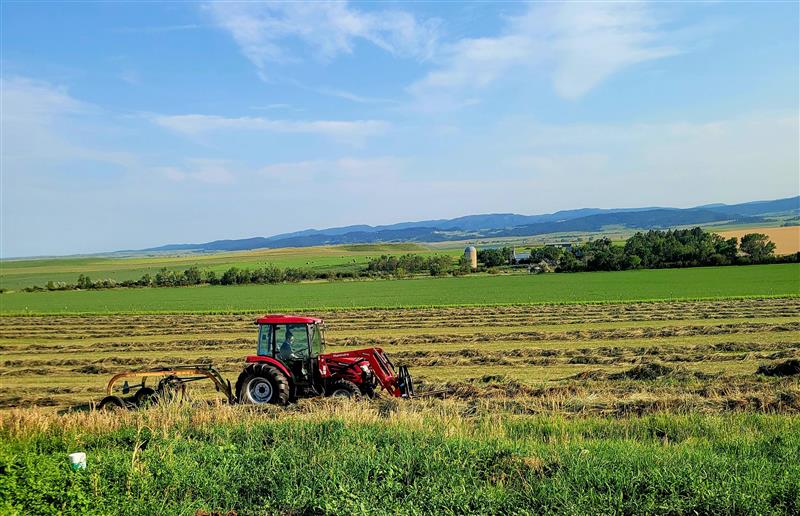
After a day of multitasking in the tractor cab cutting hay, Jared Swiontek would feel every acre. 

The combination of manually navigating the disc mower across rolling, puzzle-piece shaped fields of 60 acres or less while dodging rocks or gopher holes took a physical and mental toll. 

“Cutting hay, even on a small farm, is more challenging than people realize,” says Swiontek, who farms about 600 acres in Fergus Falls, Minnesota. “Steering the tractor, running hydraulics on the mower and looking for obstacles at 8 miles per hour all day is exhausting.”

That all changed when Swiontek added precision guidance.  

In 2025, he upgraded mowers to a New Holland 313 Plus Discbine. At the same time, he invested in Topcon’s Value Line auto steer system and had it installed on their New Holland T8010 front-wheel assist tractor.

“We had never utilized precision ag technology on the farm, because we weren’t sure the payback would justify the price,” he says. “But we wanted to take full advantage of the capability upgrades on our mower, so we were motivated to invest in a precision guidance system that made sense for our size.”

He also needed to maximize limited labor capacity. Swiontek farms with his father, Tim, but also works full-time as a seed advisor for Beck’s Hybrids. 

In addition to 250 acres of hayland, the farm grows corn and soybeans. Their alfalfa or alfalfa-grass mix is cut three times per year, with the majority round baled as wet haylage feedstock for 70 cow-calf pairs and backgrounding 150-200 feeder cattle.  

“We have a pretty active farm, and my dad is 65 years old. As he gets older, it’s going to get harder for us to accomplish as much in a day unless we make things easier,” Swiontek says. “We needed a solution that allowed us to be more productive and efficient.” 

While mid-size and large farms have long capitalized on the simplicity and functionality of auto-steer, smaller haying operations are finding an affordable, reliable entry point into precision guidance.
“We had never utilized precision ag technology on the farm, because we weren’t sure the payback would justify the price. But we wanted to take full advantage of the capability upgrades on our mower, so we were motivated to invest in a precision guidance system that made sense for our size.”

– Jared Swiontek

Scaling Payback

USDA data reports that the majority of midsize and large scale family farms in the U.S. utilize guidance technology. However, as of 2023, less than a quarter of smaller farms had adopted core precision ag systems.


Scale, cost and versatility have long been barriers to broader adoption. Small, diverse farm operations can have a hard time prioritizing precision ag investments unless it provides payback for multiple areas of the farm.


University of Georgia State Forage Extension Specialist Lisa Baxter understands these obstacles well. For many of the small hay and forage producers she works with, guidance technology is a luxury, not a necessity.

Few are in a position to buy a new tractor with auto steer, or believe they have the amount of acreage or field sizes to justify a five-figure investment. Baxter says farmers are often content to manually navigate small pastures, rather than invest in and set up guidance technology.

“If someone has a 50-acre hay field in our area, that’s phenomenal,” Baxter says. “We’ve got a lot of 20-acre hay fields, and 5-acre pastures. Most precision tech is built for a degree of scale that we just don’t see in the southeast.”

Canadian farmer Gerard Laros can relate. For nearly 20 years, he used lightbar guidance systems to seed and fertilize row crops on his diverse 500-acre farm in Arthur, Ontario. 

But he never had the confidence to use the technology for cutting 100 acres of hay silage used to feed their 80-cow dairy operation. 

“We couldn’t get the system to work with our mower setup. It was too complicated and so far off center,” he says. “I always just manually cut our hay.” 

The farm uses a Pӧttinger front mower and a Hesston swing mower for cutting hay 3-4 times per year. 

Over the years, Laros crunched the numbers on various guidance systems but didn’t find a scalable solution that fit his budget. Then in 2025, his local equipment dealership, Minto Ag, recommended the Value Line system as an economic option. 

Laros had the kit installed on their 2001 Fendt Favorit 716 Vario, which is used to cut hay and also spread fertilizer. With the necessary tractor, hydraulics and the horsepower already in place, the installation didn’t require expensive equipment upgrades or add-ons. 

“It was simply a matter of entering the implement into the software and the lines get adjusted accordingly,” said Jesse Martin, with Minto Ag. “We added the headland turn capabilities as well, so he can focus on lifting those mower discs rather than steering the tractor.” 

The benefits were immediate and measurable. 

“We’re at least 5% more efficient and saving at least a couple hundred dollars by using less fuel and getting better coverage across the field,” Laros said. “This makes the entire haying process efficient with more consistent windrows and bales.”

Going from 1-2 feet of overlap with manual steering to 6 inches or less with automatic guidance maximized cutting capacity and minimized skips. Given the cost of fuel, saving a few passes across any size field is going to have an economic benefit.

“The fuller a farmer keeps their header, the more productive they are going to be,” Martin said. “We all know that hay is very dependable in good weather. So, when farmers can cut more acres in a day, they will be less fatigued and more efficient getting the job done.”

“We’re at least 5% more efficient and saving at least a couple hundred dollars by using less fuel and getting better coverage across the field.“ This makes the entire haying process efficient with more consistent windrows and bales.”

– Gerard Laros

Window of Opportunity

Timing is often everything when it comes to harvesting quality hay. A pattern of poor weather can delay or condense the ideal window to cut high-quality forage.


“Cutting can be more time consuming than raking and baling, and we need to build in enough time for drying,” Swiontek said. “So, when we get a window, we need to push it.”


In the past, the stress of a rainy forecast often resulted in a race against sunset to cover as many acres as possible.


In 2025, showers persisted into summer hay harvest, but auto steer provided an advantage over Mother Nature that Swiontek never had in the past.

“Cutting at night with the Value Line system was a game changer because we became much more efficient,” he said. “What took us 2-2 ½ days to cut manually, we got done in 1-1 ½ days and still had drying time before the next chance of rain.”

The satisfaction of accomplishing more in a day also didn’t come with the consequence of exhaustion. 

This is a refreshing change for Laros and his father, who is in his 70s, especially when hay cutting coincides with other seasonal priorities on the farm. 

After each cutting, they utilize the Value Line system to spread manure and 180 pounds of urea with an Amazone 716 spreader.   

“In the past, my dad wouldn’t even run the tractor with our front and rear mower,” Laros says. “Now, we’ve got him set up in the cab with auto steering and even after 6 or 7 hours, he wants to keep going.” 

Growing Potential

Operational flexibility is a big reason affordable auto steer is gaining traction on small farms, says Martin. 

Since November 2024, Minto Ag has sold more than a dozen Value Line systems. Some of Martin’s customers have prior experience with precision guidance, but primarily for seeding, tillage or fertilizer application. 

For those with haying operations, the Value Line system offers a new entry point. 

“It doesn’t require a premium price or a large operation to get the ROI,” he says. “Now there is an appealing option for farmers with 100 or 300 acres of hay who can realize the payback. We see momentum building in this market.”  

In Georgia, lightbar technology has historically been the baseline recommendation for precision guidance, especially for hay and forage operations, Baxter says. 

As small farmers develop a deeper understanding of their operating costs, advanced guidance and other ag technology can begin to offer tangible return on investment. 

Adoption of advanced guidance will be a gradual process, according to Baxter, with education and information being incremental steps toward building broader momentum. 

However, she acknowledges the potential that affordable modern guidance technology holds for small hay and forage farmers.  

“There is at least a rumble and we’re having these conversations,” she said. “The willingness to discuss the payback that precision guidance offers is gaining traction.” 

As for Swiontek, he’s sold on the benefits of auto steer, and plans to add another Value Line system to the tractor they use for fall tillage. 

“The cost of equipment today compared to five or 10 years ago in terms of hours, maintenance and fuel quickly adds up on an operation our size.” he said. “Finding an affordable solution that maximizes our investments allows us to be more efficient and productive.” 

“It was simply a matter of entering the implement into the software and the lines get adjusted accordingly. We added the headland turn capabilities as well, so he can focus on lifting those mower discs rather than steering the tractor.”

– Jesse Martin, with Minto Ag

6 Precision Guidance Paybacks on Small Hay & Forage Farms

Affordable guidance systems can offer new pathways to precision payback on small hay and forage operations. Here are 6 ways auto steering can offer faster return on investment due to fuel savings, less downtime, and improved forage quality. 

1. Reduced Overlap and Misses. Precision row alignment minimizes overlaps and skips when cutting, raking, baling, or spraying. Plus, reliable, accurate guidance reduces wasted fuel, time, and machinery wear.

2. Increased Field Efficiency. Auto guidance allows for straighter passes, even in low-visibility conditions like dust or at night. This reduces stress and fatigue, allowing operators to work longer hours. Another benefit is more uniform windrows that improve baler pickup efficiency and reduce crop loss.

3. Labor Savings. Guidance systems increase labor flexibility, especially on diverse operations. A simple, yet effective system allows less experienced operators to quickly become confident and consistent with the technology.

4. Optimized Baling Patterns. Guidance helps lay out cutting and raking patterns that lead to less turning and shorter deadhead runs when baling. This improves fuel economy and speeds up field operations.

6. Higher Forage Quality. Timely and uniform cutting preserves forage quality and consistent swath width and placement improve drying and baling uniformity.

More on Value Line is available here.